Research article
INDICONOMICS
The Distance Between a Mine and a Magnet
What company disclosures reveal about the stages of rare-earth supply that are operating, contracted, planned or still awaiting a customer
MP Materials' Q2 2026 production table tells two stories at once. Its output of rare-earth-oxide content in concentrate fell 15.8 per cent from a year earlier; its finished and packaged NdPr oxide output rose 40.7 per cent. The rows measure different products at different stages of the same company's chain.
That divergence exposes the trouble with treating rare-earth supply as one quantity. A mine can produce more material without producing one more finished magnet. A magnet plant can start manufacturing before a customer has approved its product. A company can also reach a later stage through a contractor or partner without owning every factory in between.
For neodymium-iron-boron, or NdFeB, permanent magnets, neodymium and praseodymium usually enter the chain as separated oxide. The oxide must be converted into metal, made into alloy, manufactured into a magnet, tested for the required performance and accepted by a customer. Ore, concentrate, oxide, metal, alloy and magnets are different products; an announcement, a nameplate-capacity figure and an operating shipment are different kinds of evidence. The useful question is where the operating evidence stops and which later milestone remains conditional. A dated reconstruction of MP Materials and Lynas finds real activity beyond mining, but it does not put every later stage in the completed column.
Two production lines, two different movements
The absolute figures show the scale behind those opposing rates. In the three months ended 30 June 2026, MP reported 11,072 metric tonnes of rare-earth-oxide content in concentrate, down from 13,145 tonnes in the same quarter of 2025. Over the same comparison, finished and packaged NdPr oxide rose from 597 to 840 tonnes. The figures come from separate rows in MP's second-quarter results, and each percentage uses the same product's year-earlier value as its denominator.
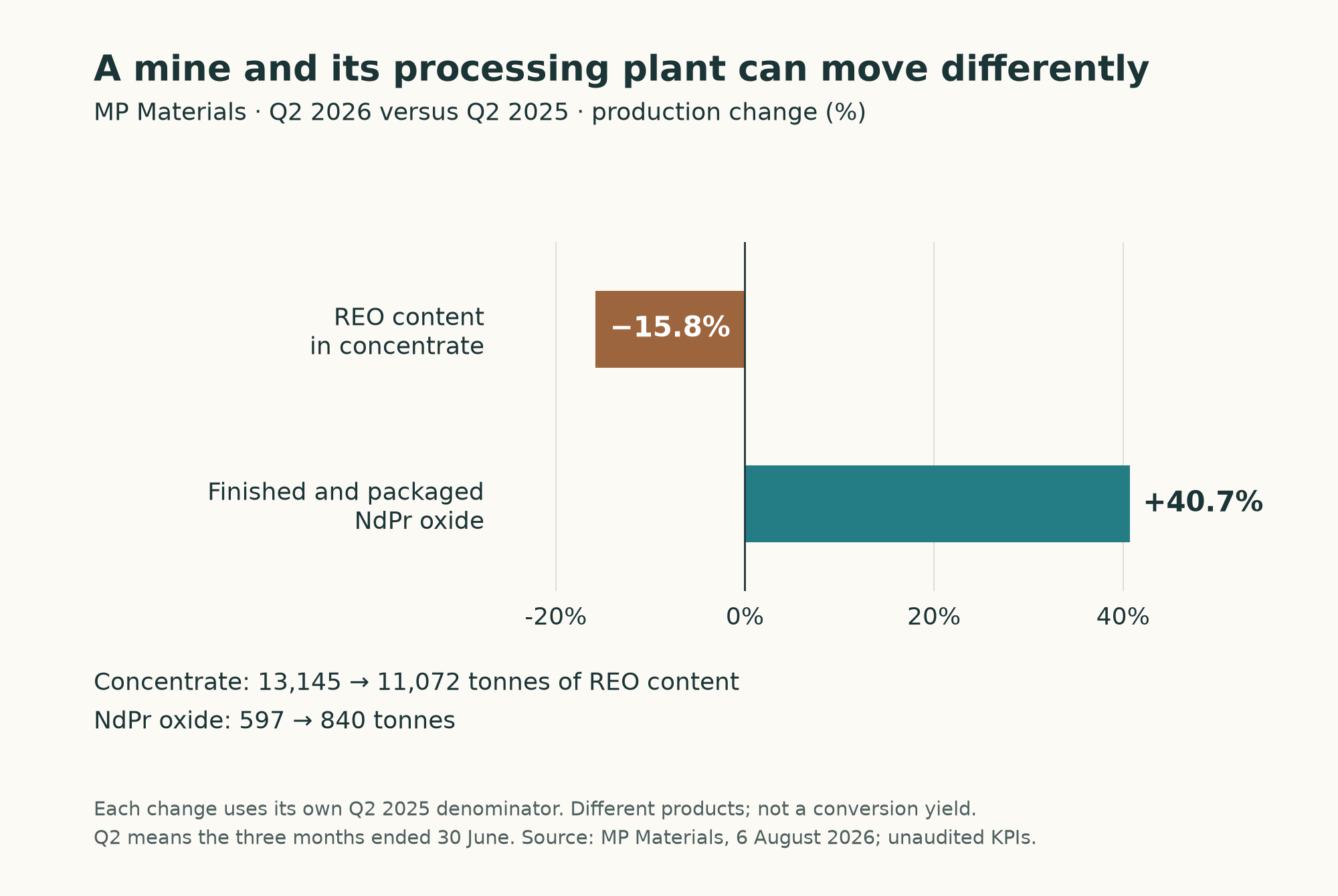
| Product, metric tonnes | Q2 2025 | Q2 2026 | Year-on-year change |
|---|---|---|---|
| REO content in concentrate | 13,145 | 11,072 | −15.8% |
| Finished and packaged NdPr oxide | 597 | 840 | +40.7% |
Source: MP Materials, Q2 2026 operational table and KPI definitions. Each percentage compares the same metric across the two quarters.
This is not a conversion yield. Concentrate contains several rare-earth elements, and MP says its concentrate measure includes material fed into downstream circuits, part of which also appears in its NdPr production measure. Inventories and processing timing can move between quarters. The two rows must not be added, divided into each other or read as a causal test. Their analytical value is narrower and stronger: even inside one company and one period comparison, upstream and separated-product output need not move together. A mine-level growth rate cannot be assumed to stand in for growth at the next stage.
MP's disclosures also show why the evidence ladder must continue after oxide. The company says its Independence facility in Fort Worth produces and sells magnetic precursor products and began manufacturing NdFeB permanent magnets in December 2025. In its 6 August 2026 results, management also reported additional deliveries for customer qualification and regulatory testing. These are substantive but distinct milestones: sales of unspecified magnetic precursor products, the start of magnet manufacturing and physical deliveries into testing.
The milestones cannot be collapsed into one. The cited operational table and segment passage do not separately report tonnage for metal, alloy or finished magnets. Qualification deliveries show that physical product has entered testing; they do not show that a named buyer has accepted it, placed repeat orders or taken recurring commercial deliveries. The absence of that evidence in the cited passages does not mean qualification failed. It does mean that testing cannot be relabelled as acceptance.
A route does not have to fit inside one company
Lynas supplies the countercase to a different mistake: equating a supply route with ownership of every stage. Its FY2026 reporting describes an operating path from the Mt Weld mine in Western Australia through chemical processing in Australia and Malaysia to separated products. For the year ended 30 June 2026, Lynas reported 7,260 tonnes of ready-for-sale NdPr. That is observed separated-product output, not magnet output, and its annual period should not be compared numerically with MP's quarterly series.
The later stages sit partly outside Lynas. Its FY2026 annual report says a planned metal-making partnership with LS Eco Energy would complement existing metal tolling arrangements. Tolling matters economically because it separates access from ownership: one company can provide material and use another processor's facilities. The cited annual-report passage does not report output from those tolling arrangements or customer acceptance. It does establish that “Lynas does not own a metal plant” would be the wrong test for whether a metal-conversion route exists.
The same distinction appears further downstream. A 7 July 2026 Lynas-JS Link announcement described a planned 3,000-tonne-per-year magnet factory in Kuantan, Malaysia, alongside JS Link's factory in Yesan, Korea. It said the Korean factory had been built, was distributing samples and was preparing for mass commercial production; it also described an exclusive material-supply agreement for both factories through January 2038. The Malaysian number is planned capacity, not annual output. An agreement is a route on paper, not proof that material has already travelled through it.
JS Link's own August 2026 update moves the Korean evidence one step forward while keeping the commercial boundary intact. In its company newsletter, JS Link reported that its 45UH magnet had completed performance qualification by the Korea Institute of Materials Science. It also said that samples had gone to global customers for evaluation and reliability verification. Full-scale mass production and supply remained planned, conditional on the completion of customer evaluations.
Those statements mark two different tests. The KIMS result is company-attributed evidence of technical grade and performance validation. The samples begin a customer evaluation, in which buyers decide whether the magnet works reliably in their own product, process and regulatory setting. The cited passage reports neither a named customer's acceptance decision nor realised tonnage or a commercial-shipment figure. It also does not show that the samples used Lynas feed. Technical qualification can therefore be complete while commercial qualification remains open.
Taken together, the two companies reject two easy stories. Mine output alone is too early a measure. Full corporate ownership is too strict a test. The defensible unit of analysis is a route made of dated milestones: observed output at one transformation, access to the next, product-specific testing and then commercial delivery. Partners can complete a route, but only evidence of their activity can establish that they have done so.
India is funding the transformations, not another mine
India's rare-earth permanent-magnet scheme is revealing because its design starts at the right place. The Ministry of Heavy Industries' March 2026 request for proposals describes an integrated sequence from NdPr oxide to metal, alloy and sintered NdFeB magnets. Its allocation envelope is up to 6,000 metric tonnes per year across no more than five beneficiaries, with 600-1,200 tonnes per beneficiary. These are programme and capacity terms. They are not current production.
The scheme also recognises that commissioning must mean more than installing equipment. Its rules require certificates covering installed capacity and the ability to manufacture sintered magnets from NdPr oxide, an auditor's confirmation that sales have commenced, and a completion process that can include inspection and testing of raw materials, intermediate products and finished goods. The sales incentive is tied to kilograms of magnets sold, subject to rate, turnover and cumulative caps. Capital support follows commissioning of the entire allocated capacity and certification. So the policy is aimed at actual oxide-to-magnet conversion and sales, rather than treating expenditure or a factory announcement as success.
But government verification under a scheme is still not the same as qualification by a motor maker. A commissioned beneficiary may have demonstrated capability and sales while evidence of acceptance by a particular buyer remains unavailable. Conversely, a customer qualification result would not by itself reveal the plant's sustained annual output. The milestones answer different questions and should remain separate.
Feedstock is where the RFP most clearly allocates risk. It points to a possible IREL route of up to 500 tonnes of NdPr oxide per year in aggregate, and only for the top three ranked bidders. Even that route depends on separate commercial agreements and letters of comfort. Elsewhere, the RFP calls potential IREL availability indicative and non-binding for bid reliance. The government expressly does not guarantee IREL's performance or delivery. Each beneficiary remains responsible for procuring its full oxide requirement and gets no milestone relief if IREL is late or supplies less than expected.
The document also uses two unresolved figures. Physical page 11 states IREL production capacity of 400 tonnes per year; physical page 35 refers to capacity to supply up to 500 tonnes per year. They may describe different concepts, but the inspected record does not say how. Neither number is an executed allocation or a record of delivered feedstock, so neither can support a calculation of the programme's “assured coverage”.
The latest dated procurement milestone in the reviewed record is an official 13 August 2026 update reporting 20 bids and the opening of technical bids. That is evidence of bidder interest and process movement. It is not an award, a letter of award, a commissioned plant, sales or magnet output. The reviewed packet does not establish that no later event occurred; it establishes only what this dated update can support.
Read in this sequence, the disclosures become a practical test of progress. Identify the physical product already made. Classify the next conversion as operating, contracted or planned. Keep technical validation, customer evaluation and commercial acceptance separate, then look for recurring deliveries at meaningful scale. Skipping one of these boundaries turns capacity into output, testing into acceptance or a mine into a supply chain.
The strongest rival explanation for uneven progress is not necessarily that one stage is an enduring bottleneck. Commissioning schedules, inventories, feedstock quality, product mix and customer timing can make adjacent stages move differently. Contract processors and partners can also supply capability that a miner does not own. The public evidence here cannot identify a globally binding bottleneck, measure the cost of a disruption or prove that a particular buyer has switched suppliers.
The record supports a bounded conclusion. MP's two production series show why concentrate growth cannot be assumed to proxy separated-oxide growth. Lynas shows that a route can cross company and national boundaries. JS Link's update separates technical validation from customer acceptance. India's scheme targets oxide-to-magnet conversion while leaving feedstock delivery risk with beneficiaries.
For India, the distinction is immediate. The RFP can support and certify integrated conversion, and its sales incentive rewards kilograms of magnets sold. Under the cited terms, however, it does not guarantee IREL delivery or turn scheme verification into a particular customer's approval. Ore in the ground is an asset. A factory is capacity. A supply chain is demonstrated when material crosses each necessary boundary often enough for customers to buy the resulting magnet again.
Sources
- MP Materials, “MP Materials Reports Second Quarter 2026 Results,” 6 August 2026: operational table; Segment Information; KPI definitions; management's second quotation on qualification.
- Lynas Rare Earths, FY2026 Annual Report, 26 August 2026: printed p. 3/PDF p. 6; printed p. 15/PDF p. 18; printed p. 17/PDF p. 20; printed p. 18/PDF p. 21.
- Lynas Rare Earths, “Lynas and JS Link announce Malaysia magnet manufacturing partnership,” 7 July 2026: physical PDF p. 1.
- JS Link, August 2026 newsletter: attachment physical pp. 1-2.
- Ministry of Heavy Industries, India, Request for Proposals for the Scheme to Promote Manufacturing of Sintered Rare Earth Permanent Magnets, 20 March 2026: physical pp. 11-18, 24, 35-37 and 41-43.
- Press Information Bureau, India, REPM scheme bid update, 13 August 2026: HTML lines 94, 98, 104 and 321-327 in the retained record.
Evidence cutoff: 13 September 2026 IST.