Research article
INDICONOMICS
What Moved When C295 Assembly Moved to India
The same 56-aircraft order shows which production tasks crossed borders, and which dependencies did not
The first C295 delivered to the Indian Air Force left Airbus’s Seville plant in September 2023 with what Airbus called an indigenous electronic-warfare suite. In June 2026, the first C295 assembled in India made its maiden test flight from Vadodara. Yet the Indian programme assigns Tata the installation and testing of engines and avionics supplied through Airbus. Indian equipment entered a Spain-assembled aircraft; externally supplied systems enter the India-assembled tranche. [1, 2, 5, 8]
That crossing is more informative than a national label. Final assembly, component manufacture, system integration and design control can point in different directions inside the same order.
India’s 2021 contract with Airbus covers 56 aircraft: 16 supplied fly-away from Spain and 40 assigned to a Tata-led production system in India. Because the customer, aircraft family and order stay fixed, the documents reveal which tasks changed location with final assembly. The tranches differ in date and production maturity, so the comparison cannot identify a causal effect. [3]
India took on detail-part manufacture and major-component assembly before the final assembly line opened. The first Indian airframe later passed through systems integration, aircraft-level testing and flight test in Vadodara. Yet the public record does not show Indian manufacture of the engines, landing gear or avionics supplied through Airbus, and C295 design and certificate control remain with Airbus’s Spanish organisation. More production stages moved to India; the network did not become nationally self-contained.
Most units moved; the percentage does not measure value
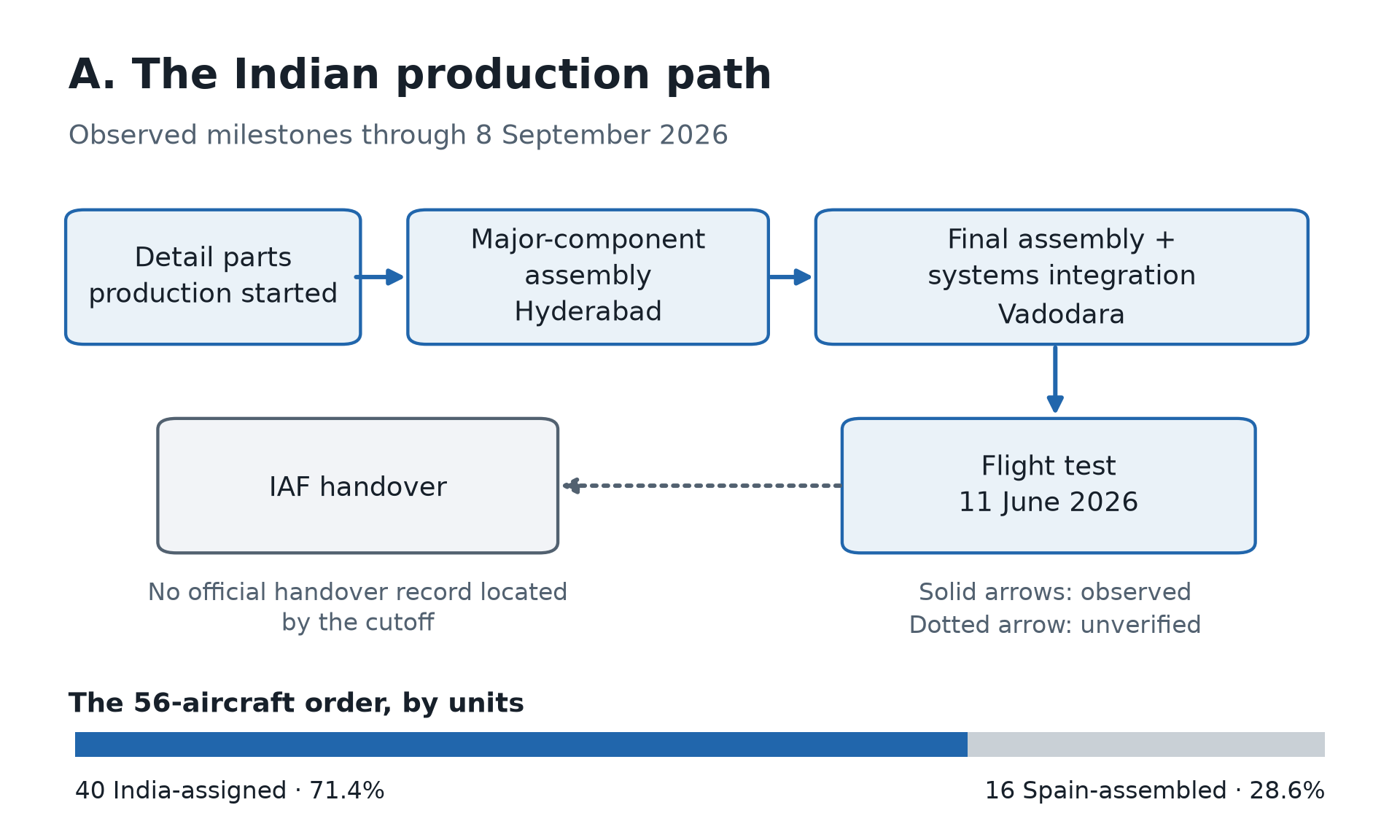
Forty of the 56 aircraft (71.4% of the order by unit count) are assigned to Indian manufacture and assembly. The other 16 were assembled at Airbus’s San Pablo Sur site in Seville and had been handed over by August 2025. By this investigation’s 8 September 2026 cutoff, the first India-assembled aircraft had flown, but an official customer-handover record had not been located. “Assigned to India” describes contracted production scope, not delivered output or value capture. [1–4]
Programme announcements offer larger percentages with narrower denominators. A 2024 government release said the first five Indian aircraft would undertake 78% of the manufacturing man-hours Airbus uses per aircraft at its Spanish facility, rising to 96% for the remaining 35. If achieved and weighted equally by aircraft, that schedule averages 93.75% across the Indian tranche. [6]
This is a labour-process target against one Airbus facility. It excludes undisclosed upstream-supplier labour and does not measure cost, profit, material origin, intellectual property or domestic value added.
Part counts have the same limitation. A 2022 government release assigned more than 13,400 detail parts, 4,600 subassemblies and all seven major-component assemblies to India. A 2024 release instead said 13,000 of 14,000 detail parts would be made in India; the joint Tata–Airbus release said 13,000 without the 14,000 denominator. The definitions are not published, and parts are not equally valuable. None of those figures can be converted into a local-value share. [5–7]
The differing counts do not make the production shift trivial. They make the tasks more informative than the headline percentage.
The Indian path begins before final assembly
Airbus reported in September 2023 that component production had started at Tata’s major-component assembly facility in Hyderabad. By October 2024, Tata and Airbus said parts for the first Indian aircraft had been shipped to Vadodara. Their joint release also recorded 21 certified special processes and 37 India-based suppliers. [1, 7]
The disclosed scope runs from detail parts and all seven major aerostructure assemblies through final assembly, systems integration, integrated testing and flight test. Tata’s current programme page also claims responsibility for engine and avionics installation and testing, rain-water testing, fleet support, modifications and upgrades. Some of that is programme responsibility rather than work demonstrated at scale. The observed sequence is shorter: production started; major components moved from Hyderabad to Vadodara; final assembly and testing proceeded there; and the first aircraft flew. A March 2026 parliamentary report placed the aircraft at final assembly and testing under India’s military aviation quality-assurance system. [5, 7–9]
Building aerostructures and taking an aircraft through integration and flight test requires process control, conformity records and system-level integration. Public evidence cannot yet weight those capabilities by economic importance. The regulator’s general approved-firms link still returned only “Coming Soon” at the cutoff. Without the C295-specific supplier and process schedule, the 37 suppliers cannot be matched to tasks, parts or value. [7, 9, 10]
The upstream network still runs both ways
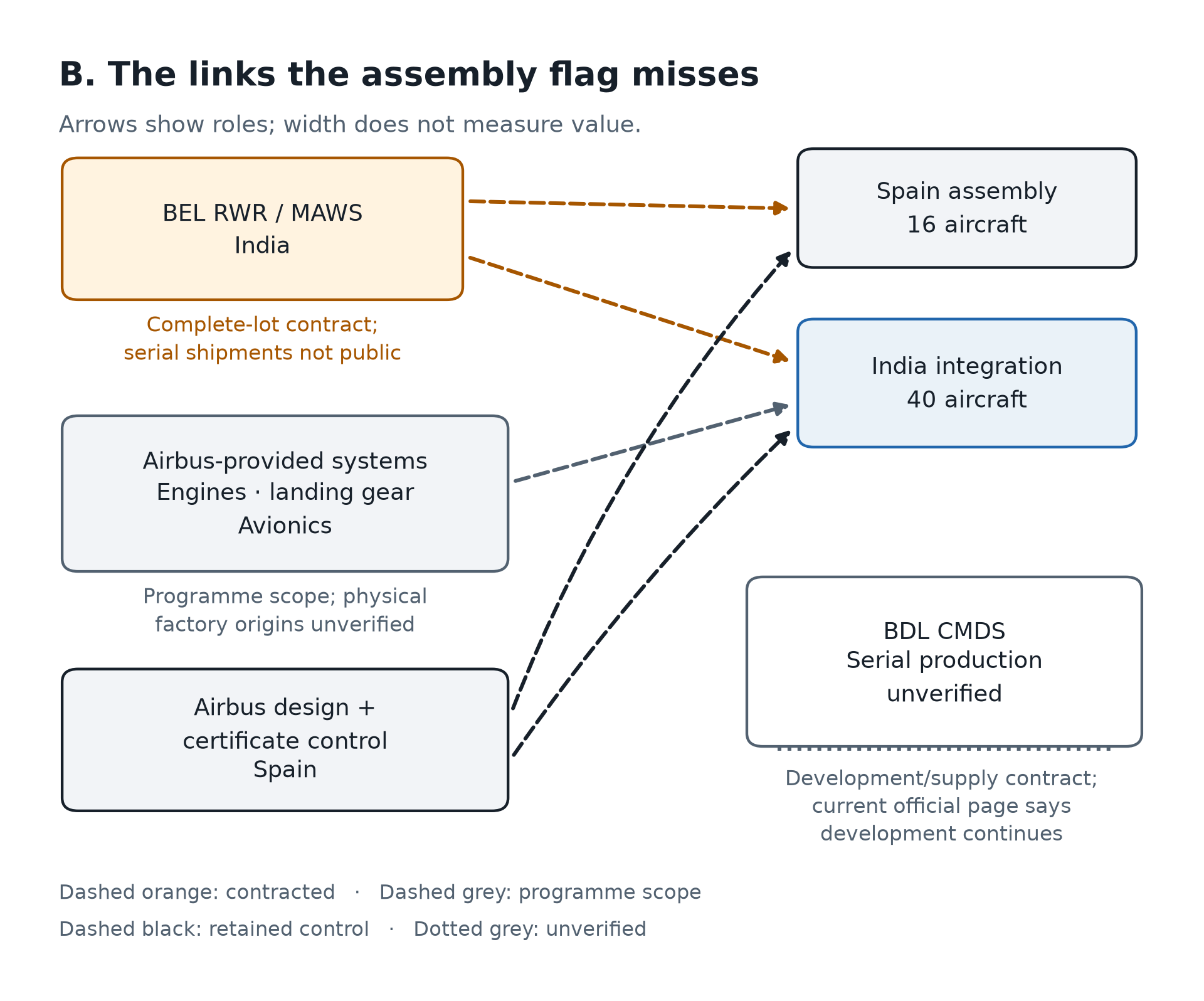
For the Indian production line, the Ministry of Defence’s 2022 description says Airbus provides engines, landing gear and avionics for Tata to integrate. Tata separately describes testing and installation of engines and avionics in India. Installation and system-level test are Indian production tasks; they do not show that the components were made in India. [5, 8]
Pratt & Whitney identifies the PW127G as the engine on the IAF’s C295. Public sources examined here do not tie the engines fitted to IAF serials to a factory. Calling them Canadian-made would substitute the supplier’s corporate identity for an unverified production origin. [11]
Héroux-Devtek’s 2022 annual report identifies the company as a C295 landing-gear supplier and assembler. The same report lists facilities in Canada, the United States, the United Kingdom and Spain without assigning C295 work to one site or identifying the IAF serials. No contract-specific official source located here names the IAF avionics configuration and production plant. A four-country bill of materials would look precise while resting on headquarters, generic platform descriptions and installation sites rather than verified component origins. [12]
An Indian upstream link crosses the assembly boundary in the other direction. Bharat Electronics Limited’s 2021 filing records an order to manufacture and supply radar-warning receivers and missile-approach warning systems for the C295 programme. In a July 2022 investor call, BEL management said the order covered the complete lot: aircraft delivered directly by Airbus and those built with Tata in India. Airbus’s first-delivery announcement provides aircraft-level corroboration that the Seville-built aircraft carried an indigenous electronic-warfare suite. [1, 13]
This establishes contracted BEL coverage across both tranches, not a factory location or serialised shipment list. The boundary is tighter for Bharat Dynamics. Its 2021–22 annual report described a contract to develop and supply the countermeasures dispensing system and planned the first two shipsets by December 2022. Later reports examined through 2025–26 contained no located C295-specific completion statement, while the current Department of Defence Production page still listed C295 development as under progress. A delivery plan and a suite-level “indigenous” description do not prove serial production of that component. [14]
Each dependency constrains a different decision. Local final assembly and system-level testing can improve the buyer’s access to production knowledge, fault diagnosis and coordination even when a component remains imported. Control of approved design data determines who may authorise a modification. Supplier location and capacity affect replacement lead times. Domestic value added answers a separate question: how much income the work generates inside India. The available documents map some tasks and approvals, but they do not measure those operational or income effects.
Nor would replacing every external input necessarily maximise capability. A specialised imported system may allow a domestic integrator to produce a more capable aircraft or learn a higher-level task. The economic test is whether the new Indian stages become competitive, repeatable and adaptable, and whether their benefits justify the procurement terms and resources committed. This evidence establishes the opportunity set. It does not supply the required counterfactual, cost data or performance record to judge the programme’s net return.
Scroll horizontally to read the diagrams. Select a panel to open it at full size.
The capability test comes after the first flight
“Screwdriver assembly” would omit detail-part production, seven major aerostructure assemblies, certified processes, systems integration and aircraft-level testing. These tasks can build repeatable production and quality routines. The documented allocation moved more than the last station on an assembly line.
The first flight also does not prove technological self-reliance. Airbus documents C295 design and engineering at Getafe, and the current type-certificate holder is Airbus Defence and Space S.A. Testing an engine in an integrated aircraft builds a different capability from designing or manufacturing that engine. [5, 15, 16]
Caliari and co-authors studied 38 countries from 2007 to 2018. They find that participation in higher aerospace stages is associated with broader, higher-quality national innovation systems. Their measures use narrow-product exports and US patents, and the relationship is correlational. The study cannot tell us what this plant caused. It does show why one assembly milestone or component count cannot settle the upgrading question. [17]
The programme changes the location of production execution while retaining dependence on externally controlled designs and systems. Its durable value will depend on what happens after the initial order: whether the same suppliers and certified processes win work on later C295s, exports or unrelated aerospace programmes, and whether Indian organisations assume responsibility for approved modifications and system design. Those outcomes would distinguish contract-specific execution from transferable capability.
The finding is therefore narrower than “self-reliance” and stronger than “assembly only.” The C295 order relocated a documented bundle of structural production, integration and test tasks. It also preserved specific upstream and design dependencies. The right unit of analysis is the task and its governing approval, not the flag on the finished aircraft.
Sources
[1] Airbus, “Airbus delivers first C295 to India,” 13 September 2023. https://www.airbus.com/en/newsroom/press-releases/2023-09-airbus-delivers-first-c295-to-india
[2] Akashvani/News on AIR, “Civil Aviation Minister expresses happiness over successful test flight of indigenous Airbus C295,” 11 June 2026. https://newsonair.gov.in/civil-aviation-minister-expresses-happiness-over-successful-test-flight-of-indigenous-airbus-c295/
[3] Ministry of Defence/Lok Sabha, Unstarred Question 319, 3 February 2023. https://sansad.in/getFile/loksabhaquestions/annex/1711/AU319.pdf?source=pqals
[4] Akashvani/News on AIR, “India Receives Final Batch of Airbus C-295 Aircraft Ahead of Schedule in Spain,” 2 August 2025. https://newsonair.gov.in/india-receives-final-batch-of-airbus-c-295-aircraft-ahead-of-schedule-in-spain/
[5] Press Information Bureau/Ministry of Defence, “Transport Aircraft for Indian Air Force to be made in India by Airbus Defence & TATA consortium,” 27 October 2022. https://www.pib.gov.in/PressReleasePage.aspx?PRID=1871267&lang=2®=48
[6] Press Information Bureau/Ministry of Defence, “Prime Minister & Spanish counterpart inaugurate TATA Aircraft Complex for manufacturing C-295 aircraft,” 28 October 2024. https://www.pib.gov.in/PressReleasePage.aspx?PRID=2068818&lang=2®=48
[7] Tata Advanced Systems and Airbus, “Tata Advanced Systems and Airbus inaugurate C295 Final Assembly Line in Vadodara, India,” 28 October 2024. https://www.tata.com/newsroom/business/tasl-airbus-c295-tata-aircraft-complex
[8] Tata Advanced Systems, “Airbus C295” programme page, retrieved 8 September 2026. https://www.tataadvancedsystems.com/c295
[9] Standing Committee on Defence, Twenty-second Report on Demands for Grants 2026–27, presented 18 March 2026, pp. 85–88. https://sansad.in/getFile/app/lsscommittee/Defence/18_Defence_22.pdf?source=app
[10] Directorate General of Aeronautical Quality Assurance, “Approval of a Firm and its Quality Management System” and linked approved-firms response, retrieved 8 September 2026. https://dgaeroqa.gov.in/afqms.html
[11] Pratt & Whitney, “Powering the Future of Flight in India,” retrieved 8 September 2026. https://www.rtx.com/prattwhitney/landing-pages-pw/powering-the-future-of-flight-in-india
[12] Héroux-Devtek, Annual Report 2022, programme page 9 and facilities table. https://www.herouxdevtek.com/images/files/document_financier/annuel/Rapport-Annuel-2022-Anglais.pdf
[13] Bharat Electronics Limited, “Airbus signs contract with BEL for C295 aircraft programme,” 22 November 2021; BEL FY2023 earnings conference-call transcript, 21 July 2022, pp. 18–20. https://bel-india.in/wp-content/uploads/2023/03/Press-Release-22-11-2021.pdf and https://bel-india.in/wp-content/uploads/2023/03/Transcript-of-the-Conference-Call-with-Investors-or-Analysts.pdf
[14] Bharat Dynamics Limited, Annual Report 2021–22, pp. 10 and 44; Department of Defence Production/Bharat Dynamics Limited, “Counter Measures Dispensing System,” displayed update 7 September 2026. https://www.bdl-india.in/sites/default/files/AnnualReport2021-22.pdf and https://www.ddpmod.gov.in/en/resources/products/counter-measures-dispensing-system-cmds
[15] Airbus, “300 pedidos del C295: historia de un líder global,” 12 March 2024. https://www.airbus.com/es/newsroom/stories/2024-03-300-pedidos-del-c295-historia-de-un-lider-global
[16] European Union Aviation Safety Agency, Type Certificate Data Sheet EASA.A.186, issue 08, 9 December 2025, CN-235/C-295; Airbus Defence and Space S.A. listed as type-certificate holder. https://www.easa.europa.eu/en/downloads/7262/en
[17] Thiago Caliari, Leonardo Costa Ribeiro, Carlo Pietrobelli and Antonio Vezzani, “Global value chains and sectoral innovation systems: An analysis of the aerospace industry,” Structural Change and Economic Dynamics 65 (2023), 36–48. https://doi.org/10.1016/j.strueco.2023.02.004