Who Pays for the Next Grid Connection?
A worked British connection example shows why the cost of building a link and the amount charged to its first applicant are different questions.
SP Electricity North West’s June 2026 charging statement describes a commercial connection requiring 70 kilovolt-amperes (kVA) of capacity. The illustrative work costs £595,000: £232,000 for extension assets connecting the site and £363,000 for eligible network reinforcement that later users could share. Yet the applicant’s charge under the ordinary demand-connection rule is £474,600. If the same work and capacity met the operator’s speculative development criteria, the applicant would fund all £595,000. The £120,400 gap comes from the allocation rule, not a change in construction cost. [1]
That £120,400 is an analytical comparison, not a reported change to anyone’s quote. The operator’s example is illustrative, and there is no record here of an actual applicant being reclassified. Nor does the difference establish who ultimately bears the cost through future network charges, property prices or any other channel. It isolates a more precise question: when future use of new capacity is uncertain, which conditions justify sharing its initial cost?
One scheme, two allocations
For an ordinary demand connection, the operator’s methodology charges the applicant for extension assets in full. Eligible reinforcement is treated differently. Within the specified voltage scope, the applicant pays the portion above a high-cost threshold of £1,720 for each kVA of required capacity, subject to the methodology’s other exceptions. In the 70 kVA example, that threshold is £120,400. The applicant therefore pays £242,600 of the £363,000 reinforcement bill, alongside £232,000 for extension assets. The result is the published £474,600 connection charge. [1]
| Same illustrative scheme | Ordinary demand rule in Example 29 | Controlled speculative-rule scenario |
|---|---|---|
| Extension work, applicant funded | £232,000 | £232,000 |
| Eligible reinforcement work, same in both cases | £363,000 | £363,000 |
| Applicant-funded share of reinforcement | £242,600 | £363,000 |
| Applicant contribution to these two components | £474,600 | £595,000 |
| Difference from ordinary contribution | £120,400 |
On a narrow screen, scroll the table horizontally.
Source: SP Electricity North West, June 2026 charging methodology, Example 29, pp. 107–108, and §§5.16, 5.48–5.51. The second column is the operator’s example; the third applies its speculative-development rule to the same assumed construction components. It excludes any additional operation and maintenance charge, taxes and other possible items.
The £120,400 gap is about 20.2% of the £595,000 two-component work cost. It equals the ordinary example’s threshold because eligible reinforcement exceeds that threshold. In this restricted comparison, if extension cost is E, eligible reinforcement is R and required capacity is C kVA, the ordinary contribution is E + max(0, R − £1,720 × C); the speculative contribution is E + R. The difference is min(R, £1,720 × C). This algebra explains the table. It is not a universal price formula: the eligible assets, voltage scope and exceptions matter, and a change in requested capacity could change the physical network design itself. [1]
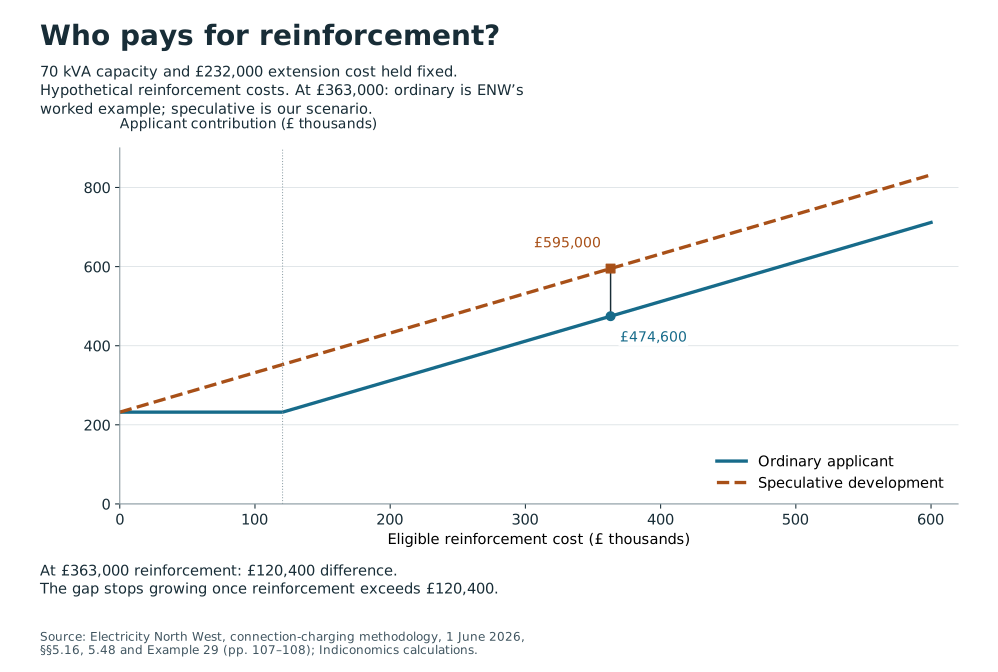
Why classify a development differently at all? Reinforcement can serve more than one user. Asking every first mover to pay for all of it could discourage a useful connection or leave future beneficiaries free to use capacity funded by someone else. But treating every proposed build-out as certain would put more upfront cost into a shared network even when later phases may never arrive. The classification rule is one way to handle that tension. It is an allocation rule under uncertainty, not a finding that one class of applicant is more deserving.
The methodology identifies features that may make a development speculative: uncertain load requirements, unclear timing for phases, capacity requested for the full development rather than its initial phases, or infrastructure proposed before end-user connections are requested. It then uses weighted criteria to assess the application. The label is not an option that an applicant simply picks, and our table is not an instruction for obtaining a cheaper classification. Ofgem’s 2023 DCP407 decision explicitly recognises that a reasonably certain phased project need not be treated as speculative. Evidence of progress and financial commitment can matter. [2]
The price distinction is consequential even before anyone discusses future bills. A project that must raise £595,000 for these works faces a different initial financing problem from one charged £474,600. Yet a lower initial payment does not show that the £120,400 has vanished, that the network operator has made a loss, or that households have paid it. Construction contributions and ultimate economic incidence are separate questions. The retained records give rules and a worked example, not the financing and billing trail for a real project.
Capacity on a timetable
Future phases bring a second issue into view: capacity is a right to draw power up to an agreed level, while electricity use is the energy actually taken over time. The capacity in this article is measured in kVA. Electricity consumed is measured in kilowatt-hours (kWh). A site could need a large connection for occasional peaks without buying a correspondingly large quantity of energy every hour. It would be a mistake to infer utilisation from the connection size, or to treat a charge per kVA as if it were a charge per kWh.
The operative methodology provides a way to make a phased request more credible. Where capacity is due to increase over time, the phases can be recorded in the connection agreement. The capacity applicable at a given time is used as maximum capacity for use-of-system charging. Agreeing a phased required capacity also commits the customer, from energisation, to charges based on the residual charging band for the complete development along the agreed ramp. The operator’s own illustration moves from 1 MVA to 5 MVA over ten years; it describes the 5 MVA commitment as arriving in line with that ramp, not as a final-band charge at its full eventual amount on day one. Current DCUSA v18.6 provisions on phased capacity and band reallocation support that reading. [3]
The ramp puts a documented payment commitment alongside a credible phased plan. Such a project can receive ordinary treatment under the classification framework, while giving the operator evidence that the applicant stands behind future demand. It does not prove the site will use the electricity it has planned for, nor does it let us calculate the value of its later payments without the actual agreement and tariff.
The separate 2026/27 use-of-system statement provides a narrower continuing-price fact. For applicable site-specific tariffs, capacity can be charged in pence per kVA per day. The chargeable capacity for a billing period is the agreed maximum import or export capacity. After agreement, a reduction is barred for twelve months; later reductions are permitted at most once in a twelve-month period, subject to agreement. Taking more than the agreed capacity can trigger an excess-capacity charge for the billing period. These are rules for the relevant tariff arrangements. The statement also names transitional-protection site-specific accounts with fixed and unit charges only, so a capacity charge cannot be assumed for every site. [4]
The statement says there is no minimum capacity threshold. That means no floor of that particular kind is stated; it does not erase a charge based on agreed capacity where one applies. Equally, the twelve-month restriction on reducing agreed capacity is not evidence of a universal minimum-revenue contract. Distribution-system invoices go to system Users, and the documents here do not establish how a given site’s distribution charge is passed through in its retail bill. Example 29 does not identify a metering arrangement or tariff category. Adding a numerical annual capacity bill to its £474,600 construction charge would manufacture a customer obligation the example never supplies. [4]
The cost of walking away
An applicant’s exit rights also depend on the terms it has accepted. SP Electricity North West currently links two different standard works forms. The business form for connections up to 300 kVA requires the operator’s prior written consent to cancellation and payment of incurred or committed costs, including allocated overheads, that it cannot otherwise recover. The major-project form permits termination on fourteen days’ prior written notice, but retains liability for unrecovered incurred and committed costs and overheads. A notice right is therefore not a full-refund right; equally, the consent requirement in the smaller form should not be imported into the major-project form. A particular accepted offer may contain special or prevailing terms. [5]
The operator’s charging methodology normally calls for full payment when the offer is accepted, while allowing agreed staged payments before committed expenditure and stating an exception. That timing explains why cancellation can matter even when no electricity has flowed: work may already have been ordered or incurred. But these generic documents do not identify which form any real applicant signed, how far construction progressed, or the amount due on a particular exit. [1, 5]
There is a possible later adjustment in the other direction. The methodology says that someone who fully funded assets may be reimbursed if a subsequent customer uses them, under the separate Electricity (Connection Charges) Regulations. That possibility helps address the first-mover problem, but it is conditional. The operative consolidated regulations were not retained in this research, and no actual second connection is documented. There is no defensible refund amount, timetable or entitlement to place in the example. [6]
When sharing is the better bet
The strongest case for the ordinary rule is that network reinforcement can serve later users. If a first applicant had to finance every upgrade that future users might need, some valuable entries could stall. Spreading eligible cost, while requiring credible evidence and a binding ramp for phased projects, can be a sensible response to uncertain but potentially valuable demand. A speculative classification can instead keep more of the initial risk with a project whose load or timing is less established. The rules try to distinguish these cases; the materials here do not test how well they do so in practice.
The worked example supplies a sharp test of what the distinction means. The same £595,000 of assumed work can produce a £474,600 or £595,000 initial contribution under the two stated treatments. Later capacity terms can also matter, but they cannot be priced for that example from the available facts. To judge a real connection, one would need its accepted offer, classification decision, connection agreement, assigned use-of-system tariff and billing record. Until then, “who pays?” has a firm answer only at the first allocation: the upfront burden depends on the rule applied to a scheme, while the final burden remains to be traced.